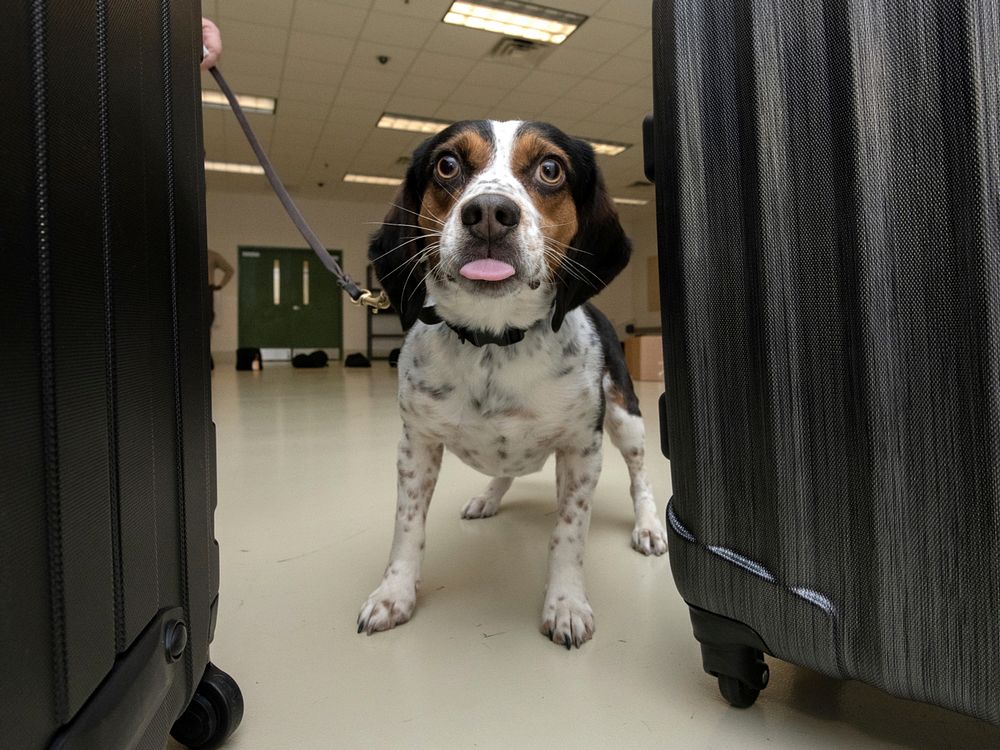
U.S. Department of Agriculture (USDA) Animal and Plant Health Inspection Service (APHIS) Plant Protection and Quarantine (PPQ) National Detector Dog Training Center (NDDTC) Training Specialist Monica Errico and Detector Dog Trainee Phillip demonstrating protocol training in Newnan, Georgia on April 4, 2019.
The center is designed and equipped to train detector dog teams (canines and handlers) to safeguard American agriculture. USDA’s Animal and Plant Health Inspection Service Plant Protection and Quarantine program and the Department of Homeland Security’s U.S. Customs and Border Protection (CBP) use detector dog teams, known as the Beagle Brigade, to search for prohibited agricultural products at major U.S. ports of entry (airports and land border crossings), mail and cargo facilities. The teams detect prohibited agricultural products that can carry foreign pests and diseases that threaten U.S. agriculture and forests. For decades, the Plant Protection and Quarantine (PPQ) program has been training canines to sniff out fruits, vegetables, and certain meat products. They have detected prohibited or restricted agricultural imports with impressive effectiveness. In 2016 alone, PPQ experts trained 67 dogs and 91 canine handlers for use by PPQ, U.S. Customs and Border Protection, State departments of agriculture, county agricultural commissioner's offices, and foreign agriculture ministries.
PPQ’s National Detector Dog Training Center started in 1984 with just one dog and one trainer. Today, the Center is located in Newnan, GA, on 17 acres with 8 buildings and 100 kennels. The Center provides standard training on inspecting passenger baggage, cargo, mail, and parcels for prohibited or restricted agricultural items.
On average, dogs have hundreds of millions of scent-detecting cells in their nasal cavities, as compared to humans who only have 5 million. In addition, dogs are able to detect a single scent among complexes of many, overlapping scents.
Related USAF story and photos of USDA handler and dog detecting brown tree snakes at an airbase in Guam.
www.af.mil/News/Article-Display/Article/587659/usda-dogs-...
USDA photo by Lance Cheung.
. Original public domain image from Flickr
Get Premium
Professional design resources and creative tools
- Unlimited downloads
- Ad-free experience
- Unlock millions of creative assets and our entire Creative Studio of editable templates, mockups and design tools